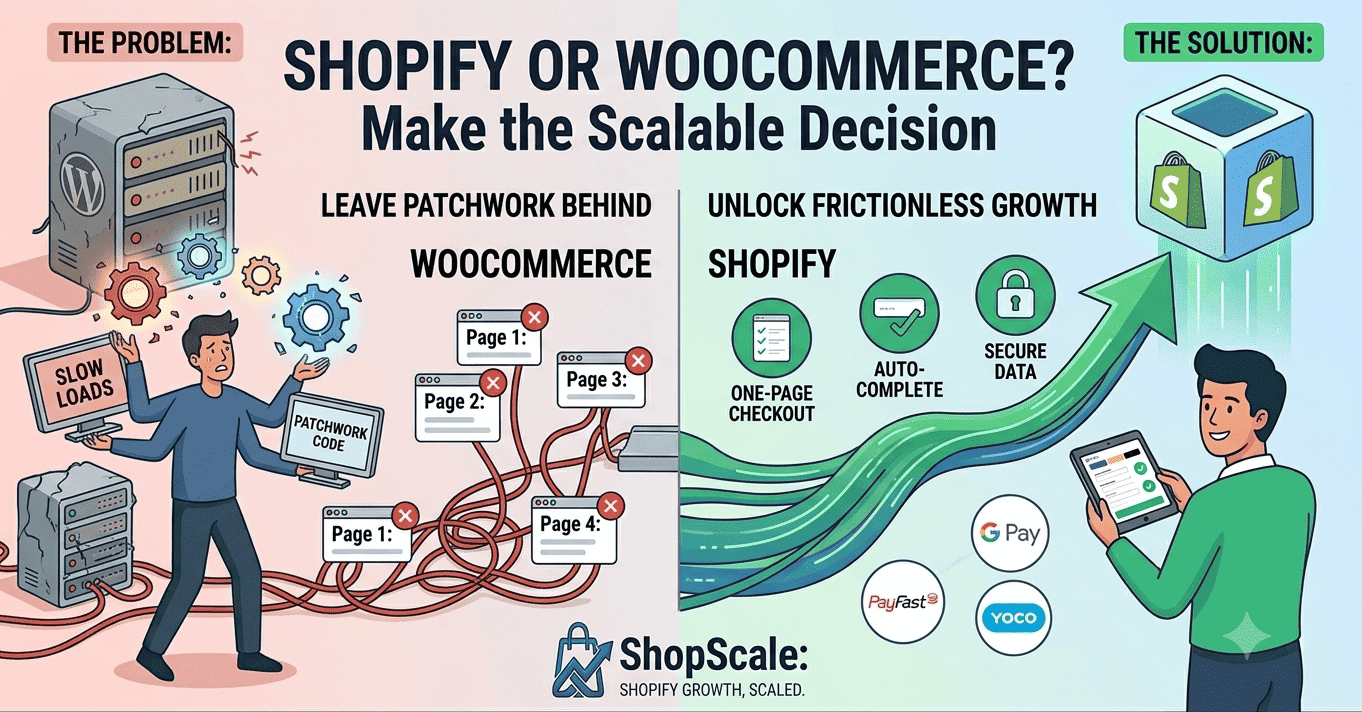
With over 71% of South African e-commerce transactions happening on mobile devices, checkout architecture is the ultimate driver of conversion rates. Legacy open-source platforms like WooCommerce and Magento often rely on fragmented, multi-step checkout plugins that drain mobile data and cause massive abandonment rates. Modernising your digital infrastructure with Shopify’s native, accelerated checkout immediately recovers lost turnover by reducing load times, removing friction, and seamlessly integrating local SA payment gateways.
Traffic is costing you a premium in Rands. Between rising Meta ad costs and competitive Google Ads bidding, South African merchants are paying top dollar just to get a customer onto their website.
But getting a shopper to add an item to their cart is only half the battle. If your checkout architecture is slow, disjointed, or requires too much manual effort, they will abandon the purchase. Current data shows that the average cart abandonment rate across South African online stores sits above 70%. That is a staggering amount of turnover left on the table.
For scaling B2B and B2C brands, the checkout page cannot be an afterthought. It must be a highly engineered, frictionless environment. South African consumers don’t have the patience or the mobile data to wait for a broken page to load.
Here is why the 3-Second Rule dictates your bottom line, and why legacy WooCommerce checkouts are actively bleeding your sales.
The Problem: Patchwork Checkouts Are Costing You Sales
When you build an e-commerce checkout on an open-source platform like WooCommerce, you aren’t using a single, unified system. You are stitching together multiple third-party plugins just to make a plan.
Your shipping calculator (pulling live rates from The Courier Guy or Bob Go) is one plugin. Your payment gateway (PayFast, Yoco, or Ozow) is another. Your loyalty programme is a third. When a customer hits Proceed to Checkout, your server has to fire multiple requests to all these different databases simultaneously.
If one of those plugins takes too long to respond, the entire checkout hangs. The customer stares at a spinning wheel, immediately questions the security of your site, and closes the tab.
This brings us to the 3-Second Rule: In 2026, if a checkout page takes more than three seconds to process an action, purchase intent drops by over 50%. A multi-page, fragmented checkout is fundamentally incompatible with modern conversion rate optimisation.
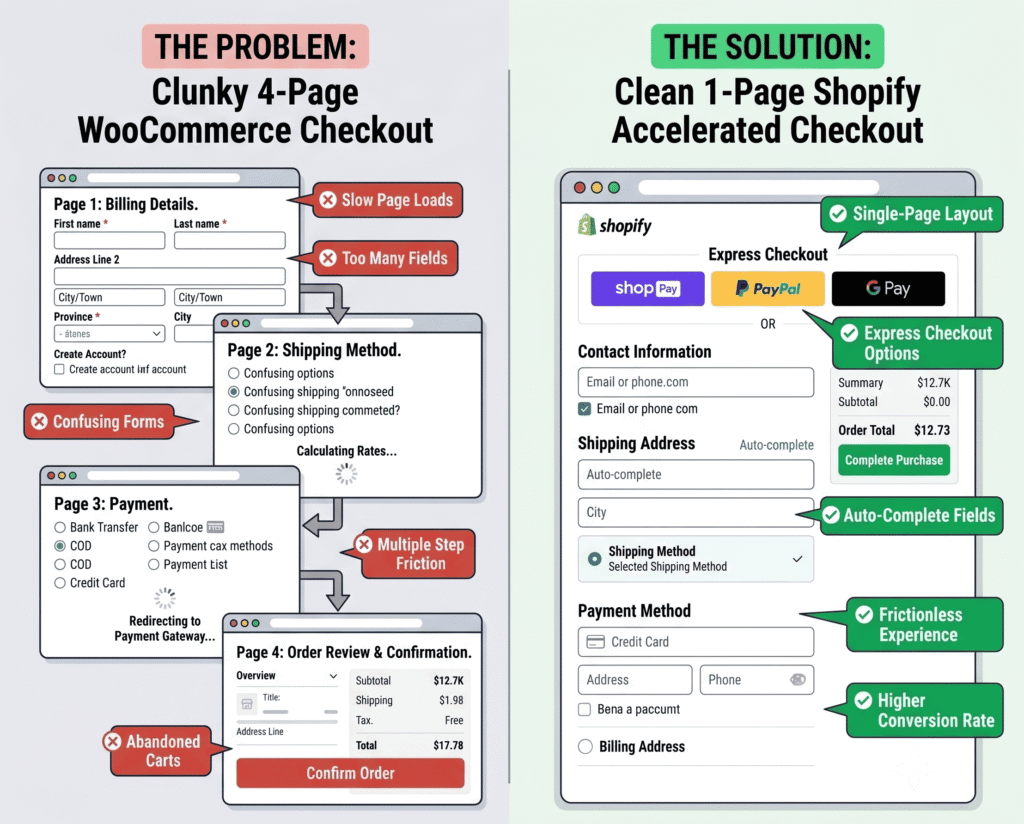
A side-by-side comparison graphic showing a confusing, 4-page WooCommerce checkout vs a clean, 1-page Shopify accelerated checkout.
Expensive Data and the South African Mobile Network
Over 71% of e-commerce transactions in South Africa are driven by mobile users. This presents a unique architectural challenge. Many of these users are shopping while commuting, dealing with fluctuating MTN or Vodacom network coverage, and actively managing their mobile data usage.
Heavy, unoptimised websites drain data. When a clunky WooCommerce checkout forces a user to load four separate pages (Cart > Shipping Info > Billing Info > Payment Gateway Redirect), every single page load is an opportunity for the network connection to drop, or for the user to simply give up.
Furthermore, forcing a mobile user to manually type in their 16-digit credit card number on a small screen is a massive friction point. If your architecture doesn’t support digital wallets or one-click checkouts natively, you are losing the mobile shopper.
The Solution: Shopify’s Native Checkout Architecture
When enterprise merchants migrate from Magento or WooCommerce to Shopify Plus, the most immediate metric that improves is the checkout conversion rate.
Shopify’s checkout is a closed, highly regulated, and globally distributed infrastructure. It doesn’t rely on 10 different plugins to function. It is a single, heavily optimised codebase that processes billions of dollars a year with 99.99% uptime.
- Accelerated Payments: Shopify natively supports express checkout options. Returning customers can check out in a single click with a six-digit code sent to their phone, completely bypassing manual data entry.
- Localised Gateways: Shopify integrates cleanly with the South African payment stack. Whether a customer wants to use Payfast, Paystack, Peach Payments, or a Buy-Now-Pay-Later (BNPL) option like Payflex, the integration is seamless and does not drag down page speed.
- One-Page Simplicity: The Shopify checkout can be configured into a highly optimised, mobile-first, one-page layout. Shipping, billing, and payment happen on a single, lightning-fast screen.
Stop Paying for Traffic You Cannot Convert
Your marketing team can run the best campaigns in the country, but if your checkout architecture is broken, your Return on Ad Spend (ROAS) will always suffer.
Improving your e-commerce conversion rate doesn’t always require a new marketing strategy. Most of the time, it requires replacing a high-maintenance legacy checkout with a modern, high-performance engine.
Is your current checkout bleeding sales? Stop losing customers to slow load times and broken plugins. Click here to book a technical conversion audit with ShopScale and see exactly how much turnover a Shopify rebuild can recover.
Frequently Asked Questions
What is a good e-commerce conversion rate in South Africa?
While global averages hover around 1.5% to 2.5%, a well-optimised Shopify store in South Africa should aim for a conversion rate between 2.5% and 4%, depending on the industry and average order value (AOV). High-ticket B2B items naturally convert lower, while fast-moving consumer goods (FMCG) convert higher.
Why is my WooCommerce checkout so slow?
A slow WooCommerce checkout is typically caused by plugin bloat and server latency. Every time a customer proceeds to checkout, the server must calculate tax, fetch live shipping rates, apply discounts, and initialise the payment gateway through multiple unoptimised third-party plugins. Upgrading your Virtual Private Server (VPS) can help, but it won’t fix the underlying architectural fragmentation.
Does Shopify Plus have a better checkout than Magento?
Yes. Magento (Adobe Commerce) checkouts are notoriously complex to customise and prone to speed issues if not heavily cached. Shopify Plus offers a highly optimised, fully hosted checkout that converts up to 36% better than standard platforms, natively supporting B2B logic, local South African payment gateways, and accelerated mobile wallets.