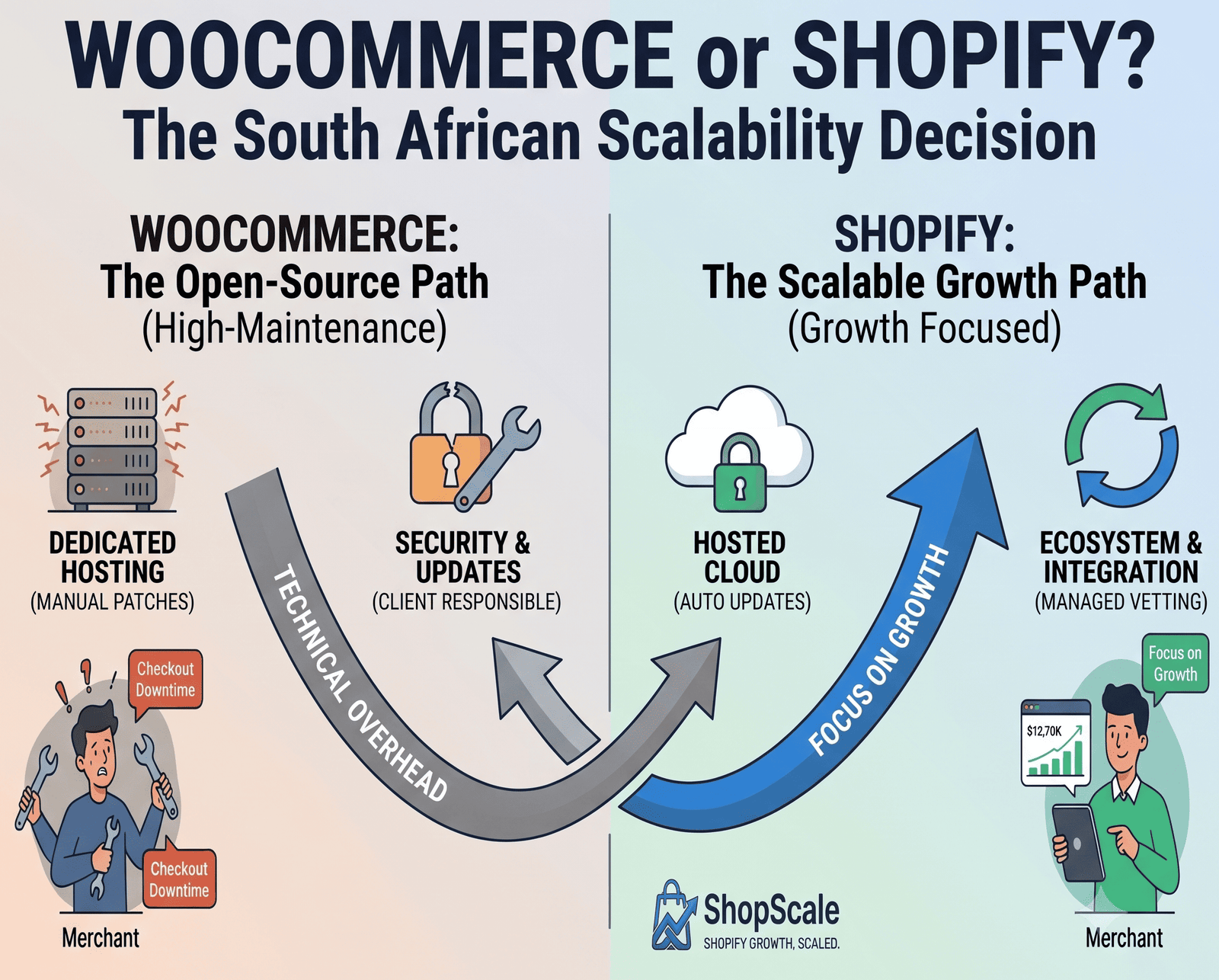
For e-commerce operators comparing Shopify vs WooCommerce in South Africa, the decision comes down to infrastructure versus maintenance. While WooCommerce and Magento offer free open-source software, they hide massive costs in dedicated hosting, security patching, and ongoing developer retainers.
In 2026, scaling South African B2C and B2B brands are migrating to Shopify and Shopify Plus to replace their IT maintenance budgets with growth and acquisition budgets.
There is a common trap that South African e-commerce founders and B2B wholesalers fall into when building their digital infrastructure. It starts with the word free.
When scoping a new build, open-source platforms like WooCommerce and Magento look fantastic on a spreadsheet. The software license costs nothing. But fast-forward two years, and that free website has usually become a financial black hole.
Between paying for expensive local server hosting, fixing broken plugins after every update, and paying a developer just to keep the checkout functioning, the true cost of ownership skyrockets.
We are seeing a massive shift in the market. Established brands are realizing that they are in the business of selling products, not managing IT infrastructure. Here is exactly why the standard WooCommerce to Shopify migration in South Africa has accelerated, and why legacy architectures are being left behind.
The Plugin Tax and Performance Bottlenecks
A fresh installation of WooCommerce is lightweight. But a fresh installation doesn’t run a R10M-a-year business.
To get a WooCommerce site to function at a commercial level, you need plugins. You need a plugin for your PayFast or Yoco gateway. You need a plugin for automated emails. You need a plugin for dynamic pricing, one for SEO, one for image compression, and one for caching.
Suddenly, your store relies on 35 different plugins built by 35 different third-party developers all over the world. When WordPress rolls out a core update, one of those plugins inevitably breaks. Your checkout goes down on a Friday night, and you lose thousands of Rands in sales before your developer clocks in on Monday morning to fix the conflict.
On top of the breakages, this plugin bloat severely impacts page speed. In South Africa, where a large portion of consumer traffic relies on mobile data networks, a site that takes 6 seconds to load will bleed conversions. Shopify’s closed ecosystem eliminates this. Apps are tightly regulated, servers are globally distributed, and the core checkout code is untouchable, guaranteeing 99.99% uptime.
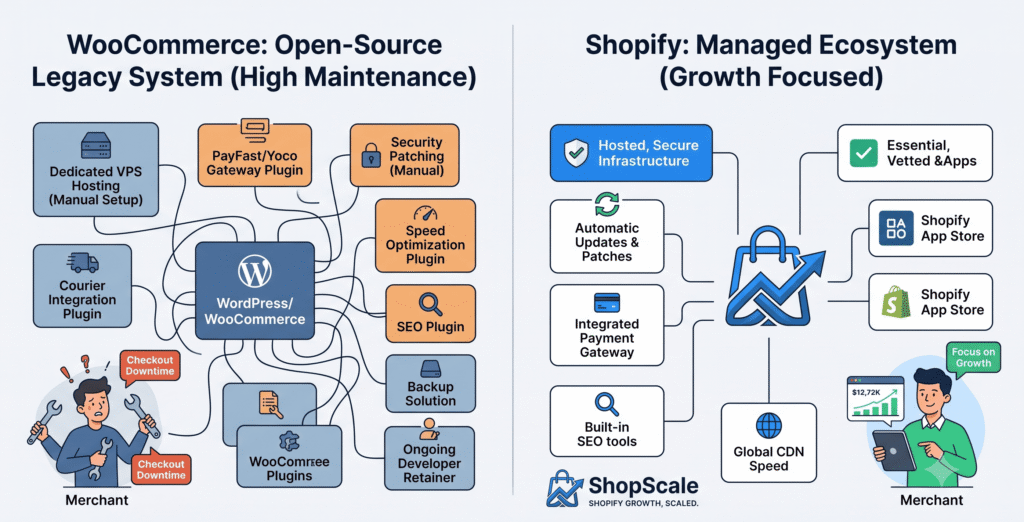
A visual flowchart contrasting a messy WooCommerce plugin setup vs a clean Shopify architecture
Security, Hosting, and the Developer Retainer Trap
If you run a serious Magento or WooCommerce store, you cannot put it on R99/month shared hosting. To handle traffic spikes without crashing, you need a Virtual Private Server (VPS) or dedicated cloud hosting, which quickly climbs into thousands of Rands per month.
Then comes security. Open-source means the code is public. If a vulnerability is found in a popular WordPress plugin, hackers deploy bots to exploit every site using it. You are entirely responsible for patching your own servers and updating your software. This forces brands to keep costly local agencies on monthly retainers just for basic maintenance.
When we audit businesses looking for Shopify developers in South Africa, we often find they are spending R15,000 to R30,000 a month on developer retainers strictly for upkeep.
Shopify is a fully managed, PCI-compliant, hosted SaaS. That means server maintenance, security patches, and bandwidth scaling happen automatically in the background. Your developer retainer can finally be spent on conversion rate optimization and custom features, rather than just keeping the lights on.
The Enterprise Shift: Magento to Shopify Plus Migration
For a long time, heavy B2B wholesalers and industrial manufacturers in South Africa believed they had to use Magento (Adobe Commerce). The assumption was that Shopify was only for B2C retail, while Magento was the only platform complex enough to handle custom pricing tiers, net-30 payment terms, and massive SKU counts.
That changed completely over the last 24 months.
With the rollout of native B2B functionality on Shopify Plus, the enterprise market is abandoning Magento. The sheer technical debt of maintaining a Magento 2 build is staggering. Upgrades can take months and cost hundreds of thousands of Rands.
By executing a Magento to Shopify Plus migration, B2B distributors get the best of both worlds: a consumer-grade, lightning-fast checkout experience that South African buyers now expect, backed by complex wholesale logic (company profiles, tiered volume pricing, and customized product catalogs).
The Bottom Line: Total Cost of Ownership
If your current website requires you to text a developer every time you want to change a banner, or if your checkout breaks during your biggest sales month, your infrastructure is actively costing you market share.
Moving away from legacy open-source platforms is no longer just about getting a prettier website. It is a calculated financial decision to lower your Total Cost of Ownership (TCO) and take control of your digital retail environment.
Ready to stop paying developers to fix broken plugins? If your legacy e-commerce architecture is holding back your revenue, it is time for a rebuild. Click here to book a technical scoping call with ShopScale to map out your migration.
Frequently Asked Questions
What is the average cost of a WooCommerce to Shopify migration in South Africa?
The cost varies heavily based on the complexity of your data, the number of SKUs, and custom integrations required (e.g., integrating with local ERPs like Syspro or Sage). Simple migrations for standard e-commerce stores can start around R25,000, while complex enterprise migrations with custom API bridges will scale higher.
Will I lose my SEO rankings if I migrate to Shopify?
If executed correctly by a technical agency, no. A proper migration protocol involves 1-to-1 URL redirects (301s), metadata transfers, and architecture mapping. When done right, moving to Shopify often improves SEO rankings over a 6-month period due to faster server response times and cleaner core code.
Is Shopify better than WooCommerce for South African businesses?
For brands generating consistent revenue, Shopify is superior due to its managed hosting, uncrackable security, and native integration with major SA payment gateways (Paystack, PayFast, Yoco) and local couriers (The Courier Guy, Bob Go). WooCommerce is only recommended for hobbyists with zero budget who possess the technical skills to manage their own servers.
Can Shopify handle B2B wholesale businesses?
Yes. Shopify Plus now features native B2B architecture. It allows South African wholesalers to run their B2C retail and B2B wholesale operations from a single unified dashboard, complete with company-specific catalogs, custom payment terms, and tiered pricing.