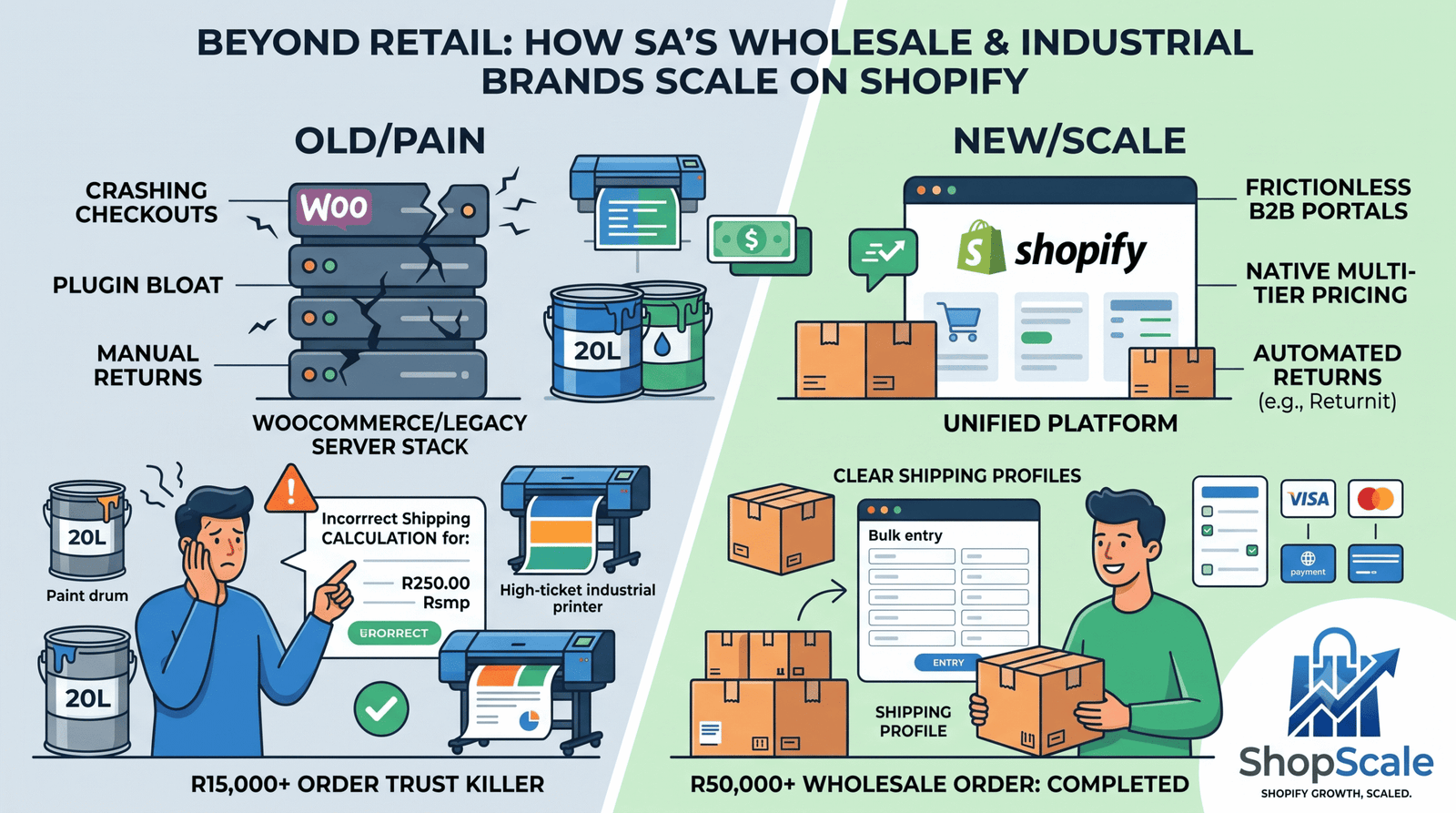
- The Misconception: Most South African merchants still view Shopify strictly as a platform for dropshippers or direct-to-consumer (DTC) fashion brands. This is a costly mistake.
- The Reality: In 2026, the most explosive e-commerce growth in South Africa is happening in the B2B, wholesale, and heavy-goods sectors.
- The Problem: Legacy platforms like aging WooCommerce or complex, custom Magento builds are buckling under the weight of custom quoting, multi-tier pricing, and heavy shipping logic.
- The Solution: Industry leaders in South Africa, from industrial printing to bulk hardware and national distribution, are migrating to Shopify and Shopify Plus to unlock automated B2B portals, high-ticket trust checkouts, and streamlined reverse logistics.
The Shift: Why Complex SA Brands Are Leaving Legacy Systems
For years, South African B2B and industrial businesses were told they needed highly complex, custom-coded websites to handle their unique operations. Today, the math has completely flipped.
Legacy open-source systems often hide massive costs in dedicated hosting, constant security patching, and expensive, ongoing developer retainers. When a platform requires a team of developers just to keep the checkout from crashing during a high-volume wholesale order, it isn’t an asset – it’s an operational liability.
| Feature Requirement | The Legacy Reality (Custom / WooCommerce) | The Modern Reality (Shopify / Plus) |
| B2B Pricing Tiers | Requires heavy, site-slowing third-party plugins. | Native B2B portals with hidden, account-specific wholesale pricing. |
| Heavy Goods Shipping | High risk of API crashes or incorrect rates at checkout. | Custom shipping profiles based on exact dimensional weight and freight logic. |
| High-Ticket Trust | Clunky, multi-step checkouts that trigger buyer drop-offs. | Frictionless, one-click accelerated checkouts (Apple Pay, Google Pay). |
| Security & Uptime | The merchant pays for manual hosting upgrades and security patches. | Fully cloud-hosted, PCI-compliant infrastructure with automatic updates. |
1. The Weight & Variant Problem: Mastering Heavy Goods Shipping
Selling a lightweight consumer item online is straightforward. Selling industrial paint, bulk hardware, or construction materials requires a fundamentally different checkout architecture.
Take a brand like Excelsior Paints in Johannesburg. When a contractor or customer navigates a catalog of specialized protective coatings, they aren’t just selecting a color; they are choosing between 5-liter tins and massive 20-liter drums.
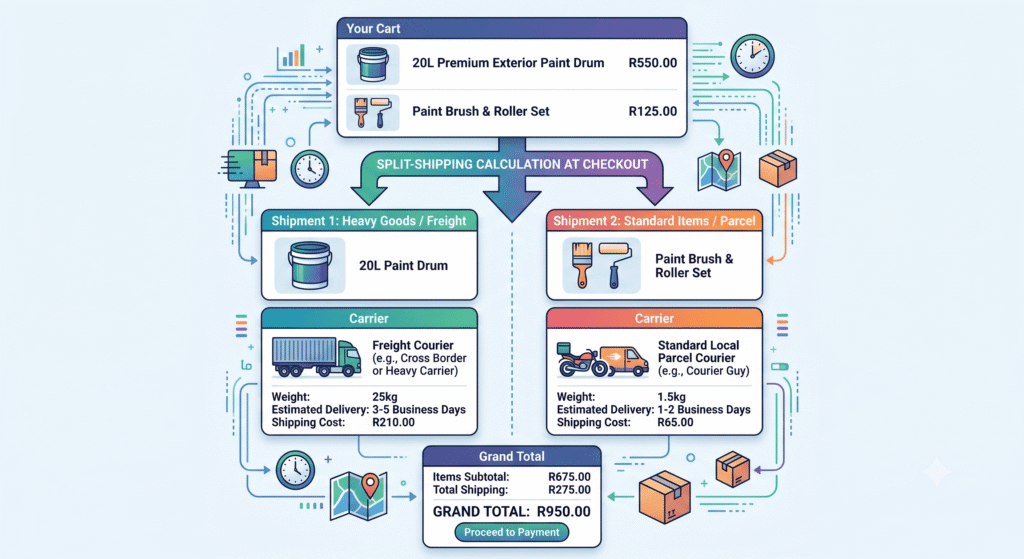
A legacy system frequently struggles to calculate real-time courier rates for a mixed cart containing both a heavy 20kg drum and a delicate, lightweight accessory. The typical result? Either the checkout crashes, or it miscalculates the shipping cost, forcing the business to absorb the financial loss.
By utilizing advanced shipping profiles, heavy-goods retailers can completely segregate their shipping logic. Bulk items can be automatically routed to freight and logistics specialists, while standard items go via standard local couriers – all calculated seamlessly in a single checkout without performance lags.
2. High-Ticket B2B: Building Trust at R15,000+ per Cart
The rules of conversion rate optimization (CRO) change entirely when your average order value shifts from hundreds of Rands to tens of thousands of Rands.
Consider a company like Packtronic in Krugersdorp, which supplies continuous inkjet systems and precise laser coders to South Africa’s manufacturing sectors. A procurement manager looking to secure a R17,000+ piece of technical equipment requires absolute digital trust and a frictionless B2B portal before committing their enterprise budget. As we’ve documented, clunky checkout architecture is choking South African e-commerce brands. A slow-loading page, broken image layouts on mobile networks, or a disjointed payment gateway will kill the deal instantly.
For high-ticket B2B e-commerce to succeed, the ecosystem must support:
- Flawless Technical Layouts: Seamless rendering of high-resolution spec sheets, video demonstrations, and downloadable technical manuals directly on the product page.
- Draft Orders & Custom Quoting: The capability for a sales representative to build a custom cart on the backend and email a direct invoice link to a corporate buyer for one-click payment.
3. The Wholesale Ecosystem: Gated Portals and Custom Pricing
For national distributors, a public-facing retail website is only half the business strategy.
Distributors like Orbit Industrial in Durbanville require a dual-purpose digital architecture. They need a public catalog to capture organic search traffic, build brand authority, and educate end-users, but they also require a secure, gated backend exclusively for their retail partners.
Modern e-commerce ecosystems eliminate the old, messy practice of running two separate websites for retail and wholesale. Through native B2B functionality, distributors can assign specific wholesale accounts to specialized company profiles.
When a verified retailer logs in, the platform instantly transforms the interface:
- Standard retail prices disappear, replaced by custom, pre-negotiated wholesale price lists.
- Bulk-order entry forms replace standard consumer “Add to Cart” buttons, allowing buyers to type in SKUs and quantities in seconds.
- Advanced B2B payment terms (such as Net-30 or Net-60 days) are automatically unlocked at checkout based on the buyer’s credit profile.
4. The Hidden Leak: Solving Reverse Logistics in South Africa
The most overlooked aspect of scaling a complex B2B or wholesale e-commerce operation is what happens after the product arrives. In the wholesale and heavy-goods sectors, returns are not just a minor customer service issue – they are a direct threat to net margins. Managing reverse logistics via manual email chains, phone calls, and spreadsheet trackers is completely unsustainable at scale.
This is exactly where the South African e-commerce tech stack has evolved. For automated returns, Returnit has emerged as the clear standard for streamlining the process.
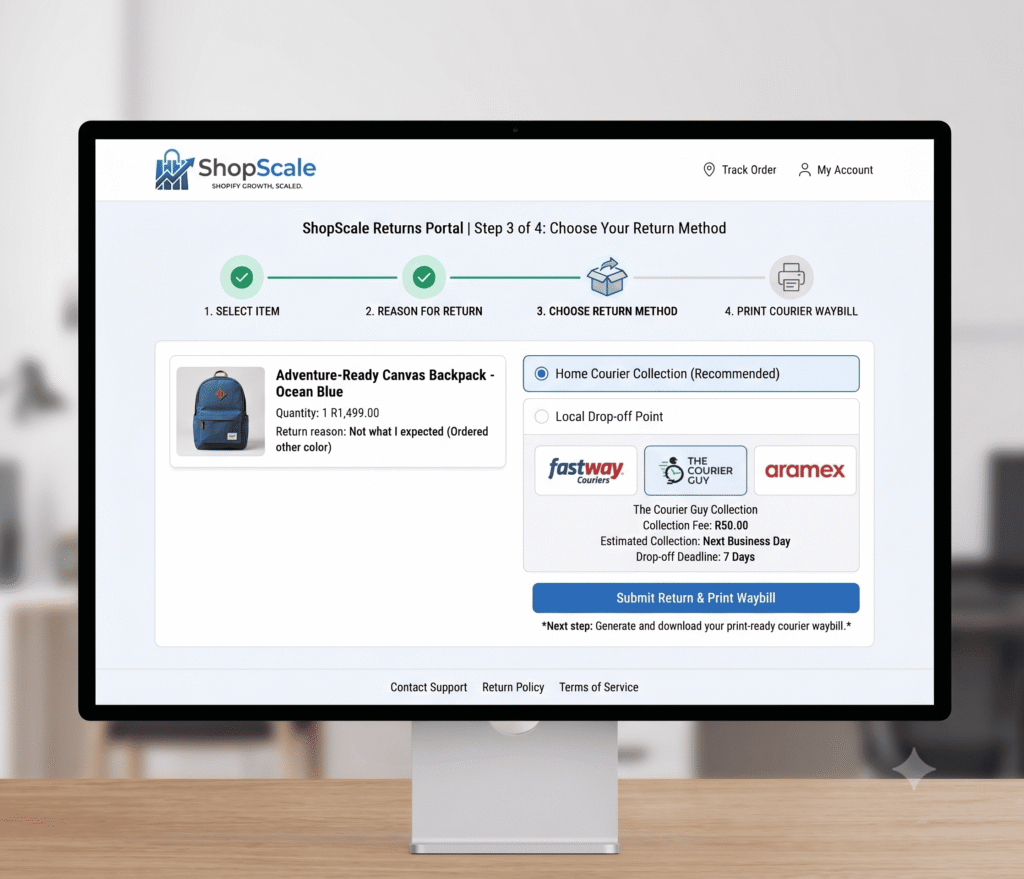
By integrating a dedicated reverse logistics platform like Returnit directly into a robust Shopify ecosystem, complex merchants can completely automate their return workflows. Wholesale buyers or retail clients can log into a branded, self-service portal, select the items they need to return based on their order history, and instantly generate a local courier waybill.
For a high-volume distributor or heavy-goods retailer, this type of integration turns a logistical bottleneck into a hands-off, automated process that protects internal staff hours and safeguards the bottom line.
How SA Brands are Winning in Wholesale
Smart South African businesses don’t just use Shopify to sell to consumers – they use it to run their entire wholesale and trade networks globally. They capture high-margin retail traffic on the front end, while gating their high-volume, complex procurement orders behind secure B2B portals.
Here are three South African brands executing this B2B architecture seamlessly:
1. Granny B’s Old Fashioned Paint – Granny B’s Old Fashioned Paint is a phenomenal example of gated B2B distribution. While their public Shopify store serves thousands of everyday consumers, their true volume is driven by a dedicated wholesale portal. Stockists and retail distributors are required to log in to access a locked catalog with dynamic, volume-based pricing and bulk ordering, completely shielding their trade margins from the retail public.
2. UB Creative – UB Creative is a masterclass in gated B2B commerce. Operating in the fashion and apparel sector, they leverage Shopify to run a strictly account-based wholesale platform. Retailers cannot even view the tailored B2B pricing or access the wholesale checkout until their trade application is approved and they are granted access to the secure login portal. This allows them to protect their wholesale margins and inventory while still utilizing Shopify’s world-class checkout infrastructure.
3. The Fieldbar Co. – The Fieldbar Co. crafts luxury cooler boxes in Cape Town that are sought after globally. While consumers can buy single units directly on their beautifully designed Shopify storefront, their real scale happens behind the scenes. They utilize a dedicated B2B Trade Portal on Shopify where international distributors and corporate gifting clients can log in, access wholesale pricing, and place massive bulk orders seamlessly.
How to Choose Your Upgrade Path
If your current online store requires constant manual intervention, developer intervention, or plugin patching just to process a standard wholesale order, you are actively losing revenue to your infrastructure.
Don’t let the complexity of your product catalog trap your business in outdated technology.
- Audit Your Mobile Load Times: If your wholesale catalog takes more than 3 seconds to load on local mobile networks, your buyers are shifting to faster competitors.
- Audit Your App Bloat: Calculate exactly how much you are spending on third-party plugins just to make basic wholesale pricing or shipping restrictions work.
- Consolidate Your Systems: Look at migrating to a unified cloud architecture that seamlessly runs public retail, gated B2B networks, and automated fulfillment under one single roof.
Is your complex e-commerce architecture holding back your scaling goals? Book a free technical audit with ShopScale today.
Frequently Asked Questions (FAQs)
Isn’t Shopify just for small retail and clothing brands?
Historically, it was viewed that way. However, with the rollout of native B2B functionalities and the enterprise-grade infrastructure of Shopify Plus, it has become the platform of choice for large-scale South African distributors and industrial suppliers. It is intentionally built to handle heavy transactional volume, complex shipping architectures, and massive catalogs without requiring constant developer patching.
Can we offer different pricing tiers for public retail customers and wholesale distributors?
Yes, absolutely. You can create completely hidden pricing tiers, volume-based bulk discounts, and custom catalogs tied strictly to specific company profiles. A regular retail customer browsing the site will only see standard retail pricing. The moment a verified wholesale partner logs in, the entire site dynamically adjusts to display their specific negotiated rates, bulk entry forms, and assigned payment terms.
How does the platform handle heavy-goods shipping and freight logistics?
Unlike legacy open-source platforms that often time out or fail when processing complex courier APIs for heavy-weight variations, a modern cloud architecture utilizes advanced shipping profiles. This allows you to set specific parameters based on dimensional weight and location, ensuring small items automatically route to local parcel couriers, while heavy industrial goods seamlessly trigger freight shipping rules at checkout.
What is the best way to manage reverse logistics and returns in South Africa?
Processing returns manually via email and spreadsheets consumes massive operational hours and cuts into wholesale margins. We highly recommend integrating a localized, dedicated automation solution like Returnit. It embeds directly into your ecosystem, providing a self-service portal where buyers can log returns and generate courier waybills instantly, keeping your backend data fully synced.